
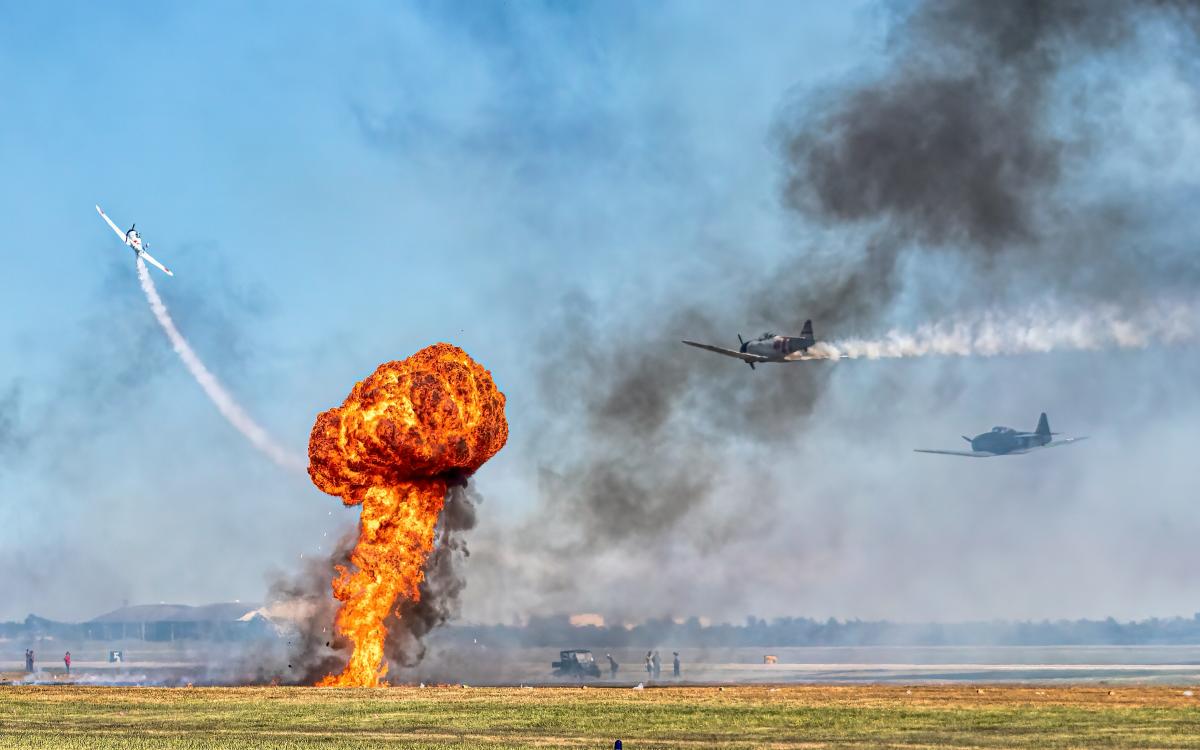
Report published by Conflict and Environment Observatory and Article 36, October, 2026.
When discussing the consequences of war, the environmental dimensions of conflict are often subordinated to immediate civilian casualties and physical destruction, despite their profound implications for human health, livelihoods, resilience and long-term recovery. Using Article 36's concept of full protection of civilians as a point of reference, the Conflict and Environment Observatory (CEOBS) argues that the full protection of civilians also requires the full protection of the environment on which they depend.
From environmental damage to civilian harm
War affects the environment through a complex set of pathways that extend across time and space. Environmental harms can be direct or indirect, immediate or long-lasting, and may spread across borders through interconnected ecosystems and economies. For example, pollutants can travel through air and water systems, while disruptions to commodity markets and supply chains can create environmental pressures far from the conflict itself. Armed conflicts can also undermine global environmental governance, and increased military expenditure may divert resources away from sustainable development initiatives.
Understanding these impacts is important not only because of their environmental consequences, but also because of the ways in which they affect civilian wellbeing. Rather than viewing the environment solely as a civilian object under international humanitarian law, the authors argue that:
"... more can and should be done to articulate and communicate how conflict-linked environmental degradation impacts people."
Specifically, they highlight that conflict-related environmental degradation can affect human health, undermine livelihoods and local economies, reduce resilience to climate and environmental shocks, contribute to broader harms to the global commons, and generate psychological distress linked to environmental loss.
This harm is often legitimised in the name of military necessity. Drawing on different cases, the report demonstrates how environmental damage can receive different levels of scrutiny depending on the conflict context. They argue, however, that the right to a clean, healthy and sustainable environment should apply equally to all civilians. At the same time, they stress that environmental harm is often complex, cumulative and uncertain, with impacts that can persist for decades and remain difficult to fully measure and address.
Towards the full protection of civilians, and the environment they depend on
The paper highlights that the full protection of civilians provides a lens that is conceptually and politically distinct from existing legal frameworks, and offers potential political traction. Moreover, they highlight a number of practical developments that could help advance this agenda, ranging from legal developments to increased visibility of conflict-related environmental damage.
Legal developments and accountability
Recent years have seen important advances in the legal protection of the environment during armed conflict, including updated International Committee of the Red Cross (ICRC) guidance, the UN's Principles on the Protection of the Environment in Relation to Armed Conflicts (PERAC Principles), and growing calls for accountability for wartime environmental damage. The authors argue that this broader body of normative and legal work should be drawn into civilian protection discussions, as a full accounting of conflict harms requires a full accounting of environmental harms.
From silent victim to sustainable recovery
Environmental harm has long been under-prioritised because it often remains unseen. Drawing on Ukraine as an example, the paper shows how satellite imagery, remote sensing, open-source investigations and growing public awareness are making conflict-related environmental damage more visible, creating new opportunities to to reorient the country towards the green transition. In this context, CEOBS suggest that this approach of "sustainable recovery", whereby post-conflict reconstruction leaves civilians better placed to live decently within their environment, should be extended to other conflict-affected contexts.
Ultimately, drawing on Article 36's concept of the full protection of civilians, the report argues that protecting civilians requires protecting the environment on which their health, livelihoods, wellbeing and future resilience depend.
This summary is based on extracts from report published by Conflict and Environment Observatory and Article 36 and written by Doug Weir. To read the full article, follow this link.
Photo credit: Edgar Serrano on Unplash / Unsplash License.