
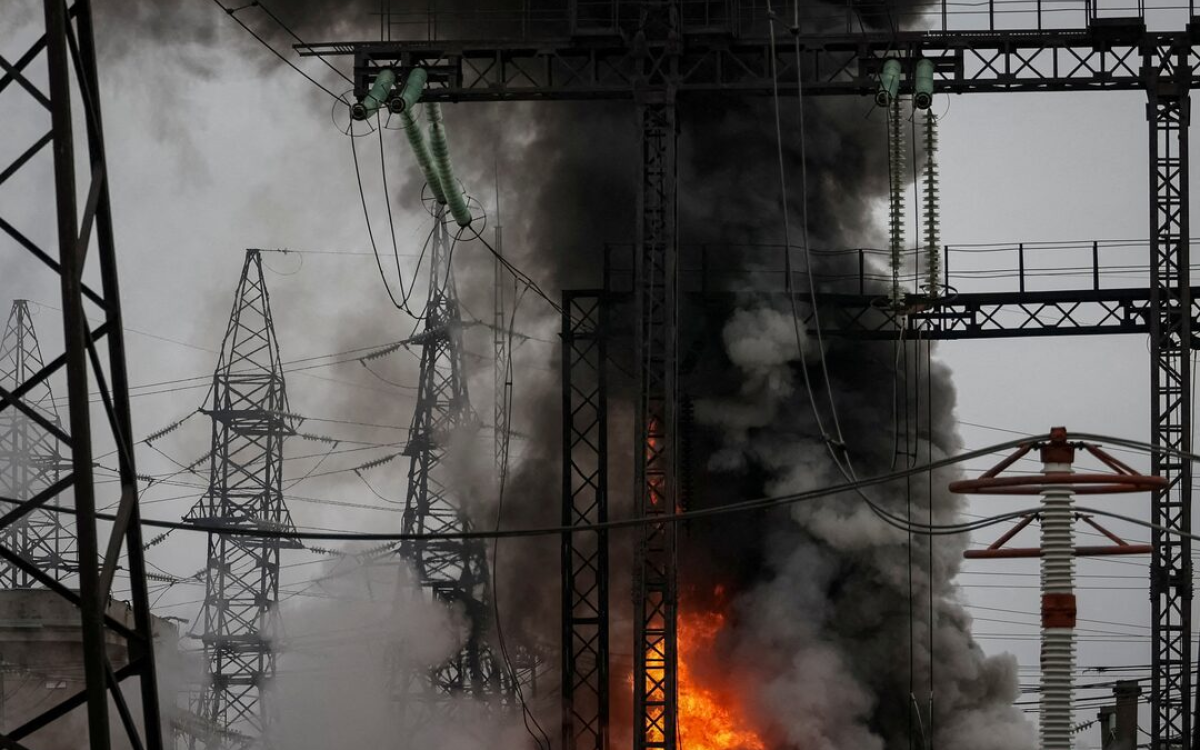
Photo credit: Reuters. Smoke and fire are seen near a high-voltage line at a site of a Russian missile strike, amid Russia's attack on Ukraine, outside Kharkiv, Ukraine, March 22, 2024.
Based on the Clingendael Powering Resilience Policy Brief.
In short:
- Energy supplies increasingly serve as instruments of coercion and targets of war.
- Amid volatile geopolitics, Europe faces a “double bind”: it must manage fragile fossil dependencies while addressing the bottlenecks that complicate homegrown expansion.
- Ensuring civil-military stability urgently requires integrated security planning and greater redundancy across electricity and liquid fuel systems.
- Aligning the civilian energy sector with defence can also channel energy innovations toward greater operational utility.
- Ultimately, pooled investments across these domains can spur lead markets for innovations with critical dual-use benefits.
European energy security: an increasingly complex challenge
Amid military escalation in the Middle East, including targeted attacks on energy facilities and obstruction in the Strait of Hormuz, Europe faces the latest energy crisis in a decade of instability. Disruptions to oil and gas flows now directly jeopardise core industrial production and civil-military stability. Under continuous pressure, the European energy security challenge increasingly necessitates rapid diversification and the expansion of domestic production. Yet, as the continent pivots towards electrification and renewables, the resilience of the entire system also depends on the strength of its interconnection, grid integration, and the strategic deployment of distributed technologies - all of which demand a new era of integrated security planning.
The Resilience Nexus
While often treated as separate silos, Europe’s readiness, security, and transition objectives converge at a critical nexus: energy resilience.
This policy brief analyses this nexus, outlining the strategic considerations and entry points linking energy innovation with the security and defence agenda. At a time when energy supplies are increasingly weaponised for political leverage and targeted to undermine stability, integrated planning is necessary to address vulnerabilities across both liquid fuel and electricity systems. This includes targeted security investments in critical infrastructure and increased system redundancy through diversified sources. Furthermore, improving the synergy between the civilian energy sector and the defence industry can help to identify niches where innovative energy solutions may provide an operational edge in efficiency, stealth or mobility. Ultimately, coordinated financing, policy alignment and pooled Research & Development can support the wider European industry by increasing economies of scale and the likelihood of cross-fertilisation with dual-use technologies, thereby supporting wider societal transition needs.
Key recommendations:
- Treat energy resilience as a strategic issue: Europe’s dependence on fossil energy imports, coupled with the rapid expansion of electricity demand, exposes systemic vulnerabilities that could severely constrain core industrial, military, and civilian resilience in a prolonged conflict. Carry out energy stress tests to identify vulnerabilities across liquid fuel infrastructure and grid infrastructure. Update and mainstream energy resilience to include these dimensions at the strategic level across the armed forces and Ministries of Defence.
- Enhance energy awareness across the force: Invest in the training and technologies required to safeguard military power resources as electrification becomes a cornerstone of energy security. Examples include intelligent systems for real-time insight into capacity and consumption to support informed decision-making, alongside integrated hybrid power networks tailored to mission-specific requirements.
- Empower European coalitions of the willing: Enable small ‘frontrunner’ groups of European MoDs and industries to move more rapidly on priority projects, such as modular power systems. Highlight that the EU and NATO have complementary interests, such as reducing foreign ownership of critical energy assets, diversifying supply chains, and enabling distributed grid infrastructure. Focus on jointly advancing interoperability and expanding security-by-design standards in core technologies and capabilities.
- Link defence and security procurement with energy-efficient investment: Recognise energy-efficient technologies as potential capability and security enhancers. Leverage the European Taxonomy for security and defence procurement to incentivise investments in innovative products and services that could enhance both civilian energy resilience and military capabilities. Consider directing InvestEU funding towards defence projects, helping to establish the defence industry as a lead market for strategic sectors identified in the Industrial Accelerator Act.
- Improve the visibility and accessibility of financing tools: Coordinate efforts across the EU and Member States to inform defence-industrial actors about innovation financing that is already available, such as the EU Defence Innovation Scheme (EUDIS). Increase the availability of private equity at the EU level, such as through the European Defence Fund (EDF), to support clean innovation with operational benefits for militaries. Leverage models to build partnerships between the defence and cleantech sectors for dual-use innovation, such as mobile battery systems.
This text is based on extracts from a policy brief written by Floor Stoelinga, Hannah Lentschig, and Louise van Schaik from the The Clingendael Institute. To read the complete piece, follow the link here.
See below for our coverage on similar topics: