
Report published by Institute of Peace and Conflict Studies and the Clingendael Institute, 12 October, 2026.
Climate change is often described as one of the few issues capable of bringing South Asian states together. Yet a new report from the Institute of Peace and Conflict Studies (IPCS) and the Clingendael Institute suggests that this assumption deserves closer scrutiny. Drawing on a Track 1.5 workshop held in Kochi, India, in May 2026, the report explores how climate change interacts with geopolitics and shapes regional priorities in South Asia. In doing so, it highlights a central paradox: while climate risks increasingly transcend borders, cooperation remains shaped by national interests. Through a simulation exercise on regional climate governance, the authors reveal the tension between designing institutions around political feasibility and around what escalating climate risks may actually require.
From shared risks to political constraints
The report identifies nine observations that help explain why regional climate cooperation remains difficult to realise in practice. Climate governance across South Asia remains largely organised at the national level and fragmented across sectoral silos, limiting a more integrated understanding of climate risks and their wider social, economic and security implications. The report notes that:
"The gap between the transboundary nature of these challenges and the national orientation of policymaking is of significant consequence."
Uneven vulnerabilities, capacities and resources further generate different priorities and expectations among states regarding the purpose and scope of regional cooperation.
Importantly, the workshop challenged the assumption that climate change represents a politically neutral entry point for cooperation. Discussions repeatedly demonstrated how familiar regional sensitivities, including questions of sovereignty, information sensitivity and representation, continue to influence climate governance efforts. Participants also questioned whether existing regional governance models and decision-making arrangements are well-suited to addressing increasingly complex and transboundary climate challenges. As a result, proposals for cooperation are often shaped less by what climate risks require than by what is considered politically feasible.
Looking ahead
At the same time, the report suggests that the weakening of global multilateral governance may create new momentum for acting on the assumption that climate change can serve as a catalyst for regional cooperation:
As the international order grows unpredictable and its multilateral institutions weaken, regions like South Asia have a stronger impetus to organise themselves against larger shocks.
Against this backdrop, climate change could become both a challenge and an opportunity for regionalism in South Asia.
Ultimately, the report argues that efforts to advance climate cooperation in South Asia must begin with a clear recognition of the region's political and institutional realities. Rather than assuming that shared vulnerability will automatically translate into collective action, policymakers must design mechanisms that can operate within existing constraints while responding to increasingly interconnected and transboundary climate risks.
This summary is based on extracts from report published by Institute of Peace and Conflict Studies and the Clingendael Institute. To read the full article, follow this link.
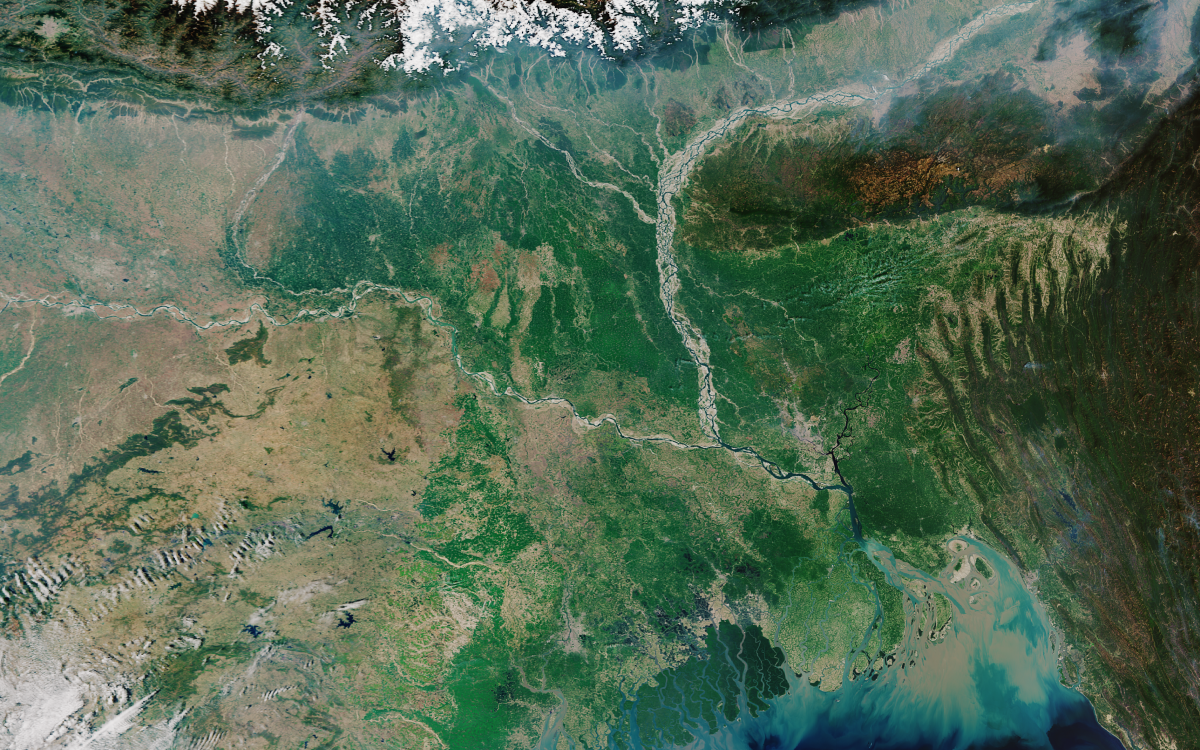
Image: Ganges Delta, captured on 31 March 2020 and featured on the Earth from Space video programme. Contains modified Copernicus Sentinel data (2020), processed by © European Space Agency (ESA). Licensed under CC BY-SA 3.0 IGO.