
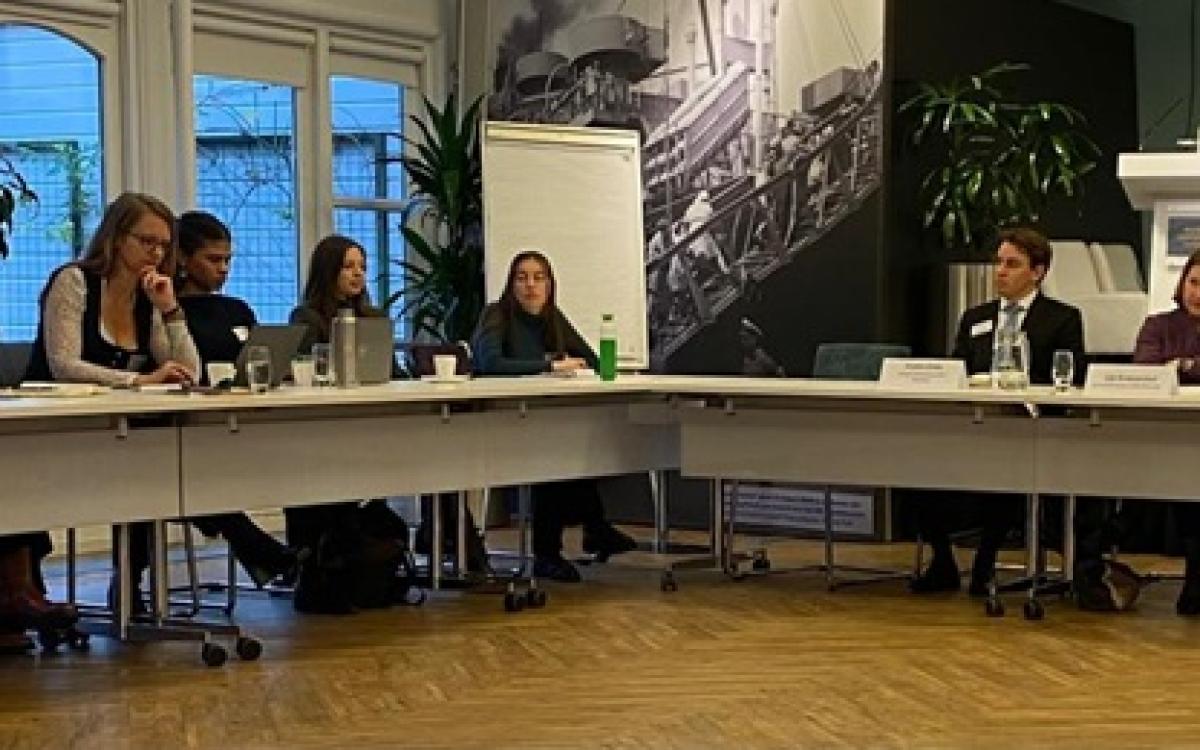
On 27 November 2025, the Clingendael Institute participated in the 18th edition of The Hague Roundtable on Climate & Security, co-organized and hosted by the German Embassy in The Hague.
The 18th The Hague Roundtable event, co-hosted with the German Embassy in The Hague brought together experts from politics, business, research, diplomacy, NGOs and financial institutions to discuss how Europe can shape its energy and climate transition in a way that is secure, competitive and resilient. Participants focused on the security and economic risks of Europe’s dependence on fossil fuels, and on how the shift to renewables can be strategically organised to address climate security risks while providing geopolitical stability.
Energy security and cooperation
Discussions underlined that Europe will not achieve its climate and energy objectives through fragmented national strategies alone, stressing the need for cross-border cooperation. This is of particular importance between major trading partners such as the Netherlands and Germany which have emerging green seaports and hydrogen hubs. Participants highlighted how shared challenges around reliability, price volatility and geopolitical shocks can become drivers of collaboration on electricity grids, ports and integrated energy systems. Speakers also noted that the traditional separation between defence, industry and climate policy is increasingly unfit for purpose, arguing for cooperation that reflects the cross-sectoral security implications of strategic energy supply choices.
A central theme was that electrification will form a substantial part of Europe’s decarbonisation, with wind power playing a pivotal role in reducing fossil fuel imports, lowering energy bills over time and creating high-quality employment in Europe. Yet participants warned that permitting bottlenecks, grid constraints, curtailment and underinvestment threaten to keep the EU off track for its 2030 wind targets, despite the economic and security advantages of scaling wind.
The need for better top-down grid planning, more flexible state aid, and an EU-wide electrification action plan was emphasized to help heavy industrial and household transition without leaving vulnerable groups behind. Climate security was emphasised as a priority, without which governments risk flying blind in an era of rising climate impacts, energy volatility and geopolitical tensions.
The roundtable explored how Germany and the Netherlands can unlock a cross-border hydrogen economy, acknowledging both the strategic importance of low-carbon molecules and the sharp recent decline in announced global hydrogen projects due to costs, policy uncertainty and infrastructure gaps. Participants argued that integrated planning of electricity, hydrogen and energy storage systems, supported by aligned national and EU-level policies, is essential to avoid simply replacing one dependency with another.
Finance, industry and just transition
Within European financing structures, participants emphasised on the fact that it is important to de-risk key parts of the transition while safeguarding public mandates and balance sheets. They stressed the importance of blending EU funds, national instruments and private capital to support companies across the “valley of death” of innovation, including wind, energy storage and hydrogen technologies, while also designing inclusive mechanisms to reach low-income households.
Civil society and NGO perspectives highlighted that social inequality, rural-urban divides and contested fossil fuel subsidy reforms could undermine the transition. They argued that narratives and financial strategies should be explicitly geared toward a just and socially grounded energy shift where no one is left behind.
Building on the topic of energy security, concerns were raised about over-dependence on a small number of suppliers for clean technologies and critical components, including China’s dominant role in several renewable and electrolysis value chains. Participants pointed to clean industrial deals, diversified trade partnerships and joint trade missions as ways to reduce dependencies, support the development of partner countries’ and align the energy transition= with broader foreign policy and climate diplomacy goals.
COP30 context and climate-security lens
From a diplomatic perspective, the outcome of COP30 was described as mixed: language on fossil fuel phase-out remained disappointing, yet there were historic gains in embedding social and just transition as a structural element of the climate regime. Experts stressed that the energy transition must be guided by climate science and justice concerns, with renewables only contributing to climate stabilization when they explicitly replace fossil fuels and are combined with deliberate phase-out pathways. To achieve this, the event highlighted increased emphasis and cooperation on adaptation by all parties.
Scientific and diplomatic contributions emphasized that energy pathways must be consistent with IPCC findings, combining rapid renewable deployment with nature-based solutions and clear fossil phase-out strategies to stay within a manageable temperature range. Examples from countries such as India, Indonesia and others illustrated how climate diplomacy initiatives and technical cooperation can help manage the “double climate crunch” of escalating impacts and tightening carbon budgets.
The upcoming report, compiled and edited by Matt Luna, Organizer and Founder of The Hague Roundtable on Climate & Security, will comprise insights, presentation summaries, and takeaways from this 18th meeting.