
Original scientific article published in nature climate change, 16 February 2026.
This article explores how the Antarctic Ice Sheet responds to global warming - and the risks connected with crossing critical tipping points.
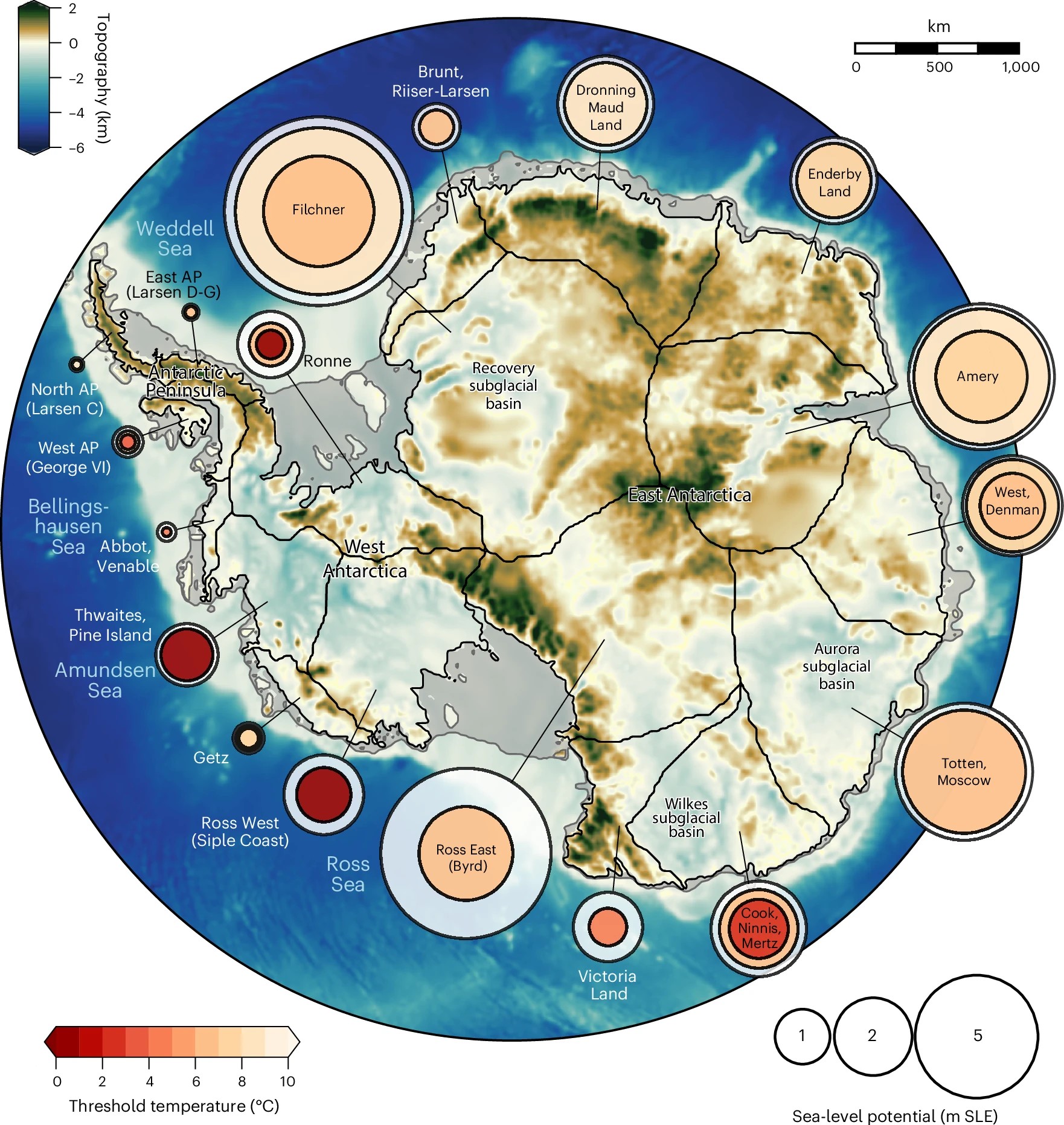
The main finding of the study is that Antarctica does not behave as a single system. Instead, it is made up of multiple and interacting ice basins, each with different dynamics. Some of them respond gradually to warming, while others exhibit tipping behaviour - where relatively small increases in temperature can trigger large-scale and potentially irreversible ice loss.
The consequences are far-reaching, including coastal erosion, ecosystem loss, human livelihood and infrastructure displacement, increased hazards from storm surges and potential groundwater salinification - as well as broader cascading effects on the global ocean and climate.
The study highlights that critical thresholds may be reached earlier than often assumed. In particular, West Antarctic Thwaites/Pine Island, Ronne and Ross West (Siple Coast) could already be close to, or even beyond, their tipping points at current warming levels (+ 1.3°C above pre-industrial levels), possibly leading to their disintegration. Crossing these thresholds could commit the world to long-term sea-level rise unfolding over the next few centuries.
These dynamics are uneven. While some East Antarctic basins show thresholds at higher levels of warming (>6°C above pre-industrial levels), others could destabilise between 2 and 5°C. Importantly, even before these thresholds are crossed, substantial ice loss and impacts are already occurring.
The message is clear: Antarctica is rapidly responding to anthropogenic climate change, with some basins already at risk of reaching their tipping point. Cutting greenhouse emissions is thus imperative to prevent further destabilisation of ice basins.
Key takeaways:
- A system of systems. Antarctica is not one tipping point, but a network of interacting ice basins with varying risks.
- Tipping dynamics matter. Some Antarctic basins exhibit nonlinear responses, where small increases in temperature can trigger abrupt and irreversible ice loss.
- Critical thresholds are closer than expected. Parts of West Antarctica may already be near tipping points under current warming levels.
- Long-term commitment. Ice loss triggered today can unfold over centuries, locking in future sea-level rise.
This summary is based on extracts from an article published by nature climate change, authored by Ricarda Winkelmann (Max Planck Institute of Geoanthropology), Julius Garbe (Potsdam Institute for Climate Impact Research), Jonathan F. Donges (Potsdam Institute for Climate Impact Research), and Torsten Albrecht (Max Planck Institute of Geoanthropology).To read the full article, follow this link.