
This article is a summary of the National Security Assessment by the Department for Environment, Food & Rural Affairs, of the HM Government of the United Kingdom (UK), 20 January 2026.
The world is already experiencing the impacts of biodiversity loss, including crop failures, intensified natural disasters and infectious disease outbreaks. This strategic assessment explores how global biodiversity loss and the collapse of critical ecosystems could affect the UK’s resilience, security, and prosperity. It considers a reasonable worst-case scenario and applies the uncertainty frameworks used in UK intelligence assessments.
Biodiversity loss impacts national security
Nature is a foundation of national security. Biodiversity loss is putting at risk the ecosystem services on which human societies depend, impacting, for example, water and food security. This has several cascading effects on Human and International security risks. Figure 1 shows the dynamics between biodiversity loss and UK national security. A major takeaway from the analysis is that resource constraints lead to greater competition between state and non-state actors, thereby exacerbating existing conflicts, initiating new ones, and threatening global security and prosperity.
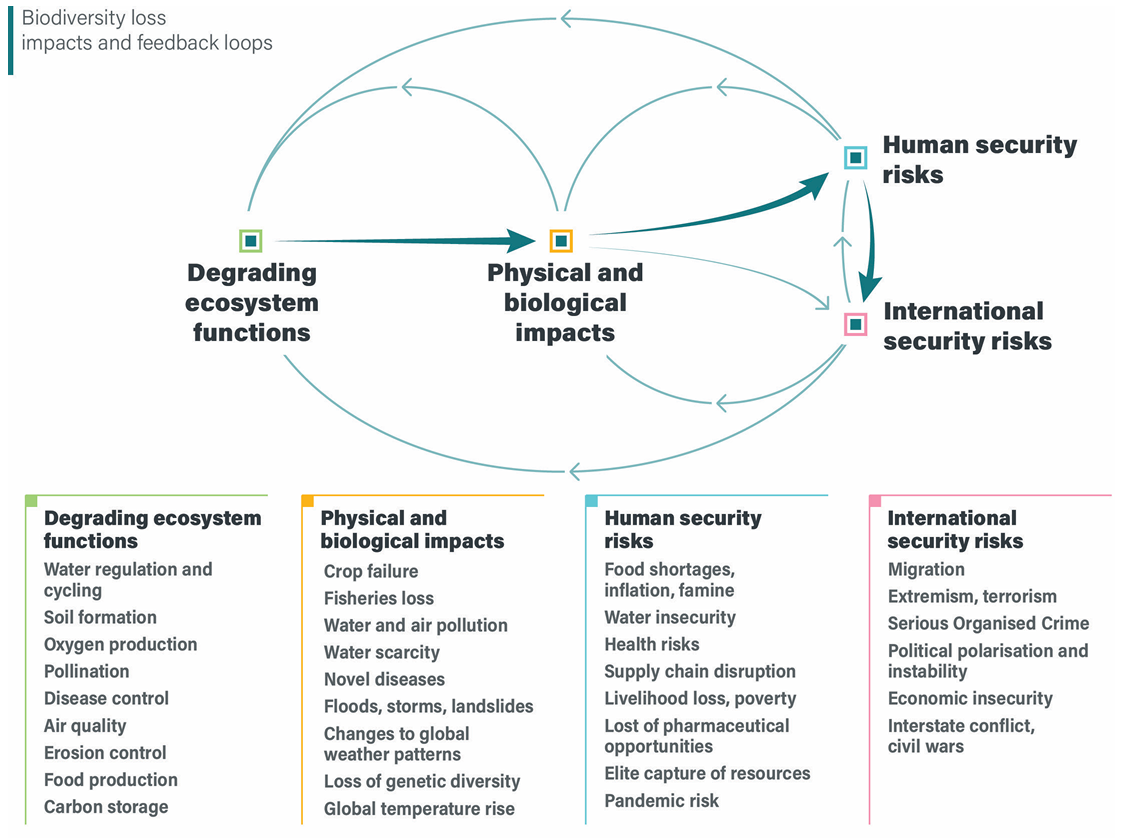
Figure 1 – Shows the interconnectedness of biodiversity loss and UK national security. Excerpt of page 6 of the report.
The report identifies six ecosystems that are critical to UK national security, given the likelihood and impact of their collapse. Severe degradation or collapse would displace millions, alter global weather patterns, intensify global food and water scarcity, and fuel geopolitical competition for remaining resources. Driving additional international security risks, as listed in Figure 1.
The UK’s food security will increasingly be challenged by ecosystem degradation or collapse, especially due to its dependence on global markets for food and fertiliser. Domestic food production is also at risk from ecosystem issues. Such degradation worldwide and within the UK would lead to increased resource scarcity and higher food prices, with significant disruptions in international markets as a result.
Main takeaways
National security will be increasingly at risk due to ecosystem degradation, which will lead to an increase in:
- Migration as development slows and more people face poverty, food and water insecurity worsen.
- Serious and Organised Crime as they will look to gain control over scarce resources and exploit people who are pushed into poverty.
- Political instability will give non-state actors, including terrorist groups, more opportunities to gain control over scarce resources.
- Pandemics as more people move between countries and the transfer of novel diseases between species becomes more likely.
- Economic insecurity as the global consumption of resources is higher than Earth can sustain.
- Geopolitical competition as countries compete for scarce resources, including arable land, productive waters, safe transit routes, and critical minerals.
- Conflict as actors compete for resources, both within and between states. Existing conflicts will be exacerbated
Photo credit Wolfgang Hasselmann on Unsplash
This text is based on extracts from a report published by the HM Government of the United Kingdom. To read the full version of the article, follow this link.