
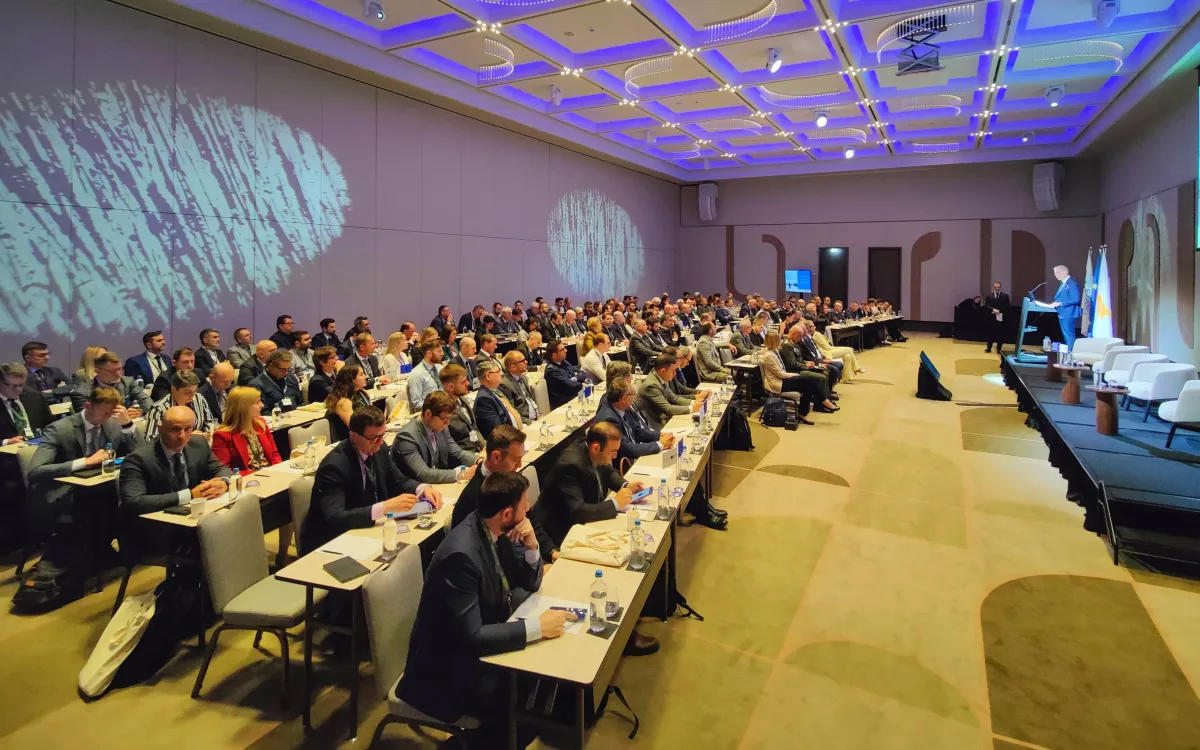
In May, representatives from various European militaries gathered in Cyprus with energy and defence experts to explore how cleantech can contribute to resilience in the defence and security sector. While this technical forum on sustainable energy (CF SEDSS), managed for years by the European Defence Agency, has long focused on clean solutions, it operated under a new and profound sense of urgency this year.
The closure of the Strait of Hormuz has left a quarter of global seaborne oil and a fifth of gas stranded overnight. The crisis marks the largest energy supply disruption in history, triggering soaring prices and causing fuel shortages across the world. As Europe faces major geopolitical instability, the traditional approach of designing energy systems solely for efficiency and affordability has also left armed forces profoundly exposed to sudden, systemic disruption. As Anders Sjöborg, Deputy Chief Executive of the European Defence Agency (EDA), put it:
"A force that depends on fragile energy is a force at risk."
The conference highlighted that energy resilience has become a core pillar of strategic autonomy and operational capability. For European militaries, fuel dependencies could translate into a crisis when shortages threaten core operational capacity - from air defence to mechanised ground movement.
General Tom Middendorp (Ret.), Chairman of the International Military Council on Climate and Security, highlighted that two urgencies are converging: climate change and energy security. He noted that accelerating the energy transition is a strategic necessity to strengthen defence resilience and reduce vulnerable dependencies. Panagiotis Hadjipavlis of the Cypriot Ministry of Defence echoed this sentiment, calling energy resilience a "measurable, engineerable, and operationally decisive capability."
Energy as a strategic Capability
To think about how energy innovation could benefit operational resilience in the security and defence sector, the conference focused on three domains:
- Operational & Technical: Deploying AI and smart grids to optimise energy demand and protect defence infrastructure from physical and cyber threats.
- Financial: Channeling defense priorities into EU funding instruments - like Horizon Europe and the European Defence Fund (EDF) - to boost public-private cooperation.
- Commercial: For the first time, the forum included a live exhibition to showcase ready-to-deploy private sector solutions, such as battery storage, microgrids, and hybrid systems.
To translate these concepts into practice, the forum operates through three technical pillars: 1) energy efficiency and building performance; 2) renewable energy sources and 3) infrastructure protection. Additionally, a Transversal Working Group - led by participating Armed Forces and Ministries of Defence (including the Dutch Ministry of Defence) - oversees policy, management, and innovation.
Through this streamlined framework, the forum is currently delivering 30 defence-energy project ideas, four research studies, and strategic roadmaps to help Ministries of Defence make better, more resilient energy decisions.
Takeaways: Four Critical Challenges
The disruption of fossil fuel supply in relation to the closure of the Strait of Hormuz in combination with pipelines, refineries and oil production sites being target of war are a wake-up call for militaries. Echoing recent Council Conclusions:
An accelerated energy transition and clean innovation offer a path out of this vulnerability. However, operationalising this ambition also requires facing many challenges:
1. Rejecting the "Silver Bullet" Trap
The transition will be a gradual, step-by-step process. There is no single, elegant green solution that will instantly solve defence energy vulnerabilities while simultaneously increasing mobility in a 100% sustainable way. Instead, it will require a diverse, hybrid, whole-of-system approach built on multiple distinct investments and technology neutrality.
Ultimately, green solutions are only viable for militaries if they preserve a definitive warfighting edge or national security imperative. This requires innovators to engage with requirements and standards from early-stage development, and defence ministries to think about multiple parallel, modular solutions across their energy systems and materiel. Striking the right balance between systemic resilience at large and immediate battlefield mobility introduces distinct opportunities and challenges; which is precisely why the technology variety and private-public engagements during the conference were so vital.
2. Factoring in the Hybrid Security Angle
As the sector adopts sustainable technology, resilience investments must go far beyond the hardware itself. This is true for rigorous "proof of concept" validation for deployment in the field, but also for systematic resilience at home. This means designing systems that can withstand a wide range of threats, including grid instability, balancing issues, technological risks, natural disasters, and deliberate hybrid, cyber, or terrorist attacks. Integrating new systems comes along with new vulnerabilities, ranging from critical raw material supply dependencies to digital hick-ups. Managing these risks requires a continuous pipeline of supporting counter-technologies and security planning.
3. The Challenge of Scale, Interoperability, and Uptake
While the on-sight technology exhibition proved that the necessary clean technology is rapidly improving and often already exists, a critical scaling challenge remains. Many of Europe’s clean-tech innovators operate on a small scale and need support to move through the R&D phase toward viable proof of concept and, ultimately, commercial uptake. Navigating this hurdle will require defence ministries to demonstrate a greater risk-appetite and collaboration.
While frameworks like Horizon Europe, the EDF, and EDA’s CapTech projects provide vital pathways towards more interoperable European solutions, they do not yet offer a guaranteed route to uptake. Moreover, many SMEs are still struggling to find their way into European (defence) investment programs due to their heavy administrative burden. The financial support available is also divided into many small portions, whereas a true scale-up requires bigger sums.
4. Shifting from Support to Shaping
A massive wave of relevant energy legislation has been emerging from the EU, including the Energy Efficiency Directive (EED), the Renewable Energy Directive (RED), the Critical Entities Resilience (CER) Directive, and regulations surrounding the security of gas supply and risk preparedness in the electricity sector. Because the defence sector relies heavily on civilian infrastructure and energy systems, these initiatives are increasingly shaping the defence and security landscape. Yet ministries of defence remain largely passive participants in the policy process, focusing mainly on securing derogations and defining operational red lines. The CF SEDSS Forum supports the implementation of established frameworks, but is an intergovernmental body connected to the European Defence Agency and is not (officially) connected to the European Commissions’ DG for Defence and Space (DEFIS) or Energy (DG ENER).[1]
This is where a major strategic opportunity is missed: involving defence actors earlier in the policy cycle through exchange with DG DEFIS/ENER and by connecting to energy policy colleagues in EU capitals. This needs to happen during the policy initiation and drafting stages. Rather than reacting to legislative proposals, national ministries of defence and the European Commission could work together proactively to ensure military requirements and national security considerations are integrated from the outset. The next phase of the CF SEDSS Forum could play a role in enabling this early-stage, more strategic engagement by working more closely with the European Commission DG DEFIS and its energy counterpart DG ENER.
Bottom Line and Outlook
Ultimately, forum demonstrated that sustainable defence technology is making significant strides through the combined efforts of European Member States, the private sector, and frameworks like EDA CapTech, EDF, and NATO DIANA. Amid rising energy supply chain pressures, energy resilience has become central to modern security planning. The Forum contributes to this goal by fostering research, building capacity, and sharing best practices. While the CF SEDSS Forum already leverages technical expertise effectively through its working groups, its ability to translate dialogue into tangible outcomes could be strengthened through greater political ownership and higher-level participation, particularly given the urgency of acute supply disruptions and vulnerabilities.
With the massive climate and geopolitical challenges ahead, keeping up this momentum is vital - not just for driving innovation, but for addressing both existing and new vulnerabilities and securing civilian and military energy systems. While strengthening defence through energy resilience and innovation is ultimately a long-term effort, and one that faces many challenges, it could be key to addressing the critical choke points facing the sector today.
- The Planetary Security Initiative (PSI) participated in the 3rd Plenary Conference of the Consultation Forum for Sustainable Energy in the Defence and Security Sector (CF SEDSS IV) and the first Energy Technology Solutions (ETS) Exhibition in Nicosia, Cyprus. Under the auspices of the Cypriot Presidency and hosted by the Cypriot Ministry of Defence, the event brought together 26 EU countries, over 180 experts, and 21 exhibiting companies. PSI would like to thank the European Defence Agency for the invitation and excellent organisation of the conference.
[1] Though DG ENER was represented at the conference.
Floor Stoelinga, Researcher PSI.
This article contains excerpts from the European Defence Agency:
Enhancing Defence Energy Resilience through Sustainable Innovation
Consultation Forum as a key platform for advancing sustainable energy systems in defence
Photo credit: ©Third Consultation Forum for Sustainable Energy in the Defence and Security Sector (CF SEDSS) IV plenary conference