
Commentary published by Carnegie Endowment for International Peace, August 27, 2026.
How do climate change, cartels, and government responses intersect in Central and Latin America?
As more countries in Central and Latin America have joined the "Shield of the Americas" - U.S. President Trump's new flagship security architecture, created with the aim of fighting cartels in the region - this commentary tries to evaluate the potential of such a framework to structurally tackle the endemic violence and resilient illicit economies in the region.
While hard-security approaches to cartels and violence have proven succesful, at least on paper, in reducing homicide rates and increasing the perception of security, these went hand in hand with strong concerns over justice and transparency issues related with mass imprisonments and human rights protection.
Most importantly, argue the authors, the Shield's design, and its underlying hard-security approach, insufficiently tackles the multidimensional challenges that create and sustain the structural causes of violence in the region. Among them, climate shocks.
These, and the connected socio-economic implications - such as poverty and social exclusion - create fertile ground for the recruitment operations of cartels. Military force alone, then, cannot fill this governance vacuum, and risks even reinforcing societal mistrust that lets cartels present themselves as a more reliable source of authority.
To enhance the Shield's capacity to bring durable security to the region, the authors suggest tackling cartels' violence by combining hard security with approaches that address the root causes of insecurity. In particular, they suggest to:
Build environmental risk into the threat assessments that the Shield plans to conduct. These should map climate risks (drought, storm exposure, etc.) against cartel recruitment.
Employ militaries for stabilization purposes, not just interdiction. This would imply committing military forces to climate-resilience-enhancing efforts such as restoring roads and water access.
Think beyond hard-security-only approaches. This requires looking toward durable security grounded in positive peace.
The message of the commentary is clear: climate change, illicit economies and governance go hand in hand. To respond, policy should combine hard-security approaches - bound to international and domestic laws - with measures that tackle the structural causes of violence. First and foremost, climate shocks.
This summary is based on extracts from a commentary published by Carnegie Endowment for International Peace and written by Alejandro Martin Rodriguez (Carnegie) and Kayly Ober (Carnegie). To read the full article, follow this link.
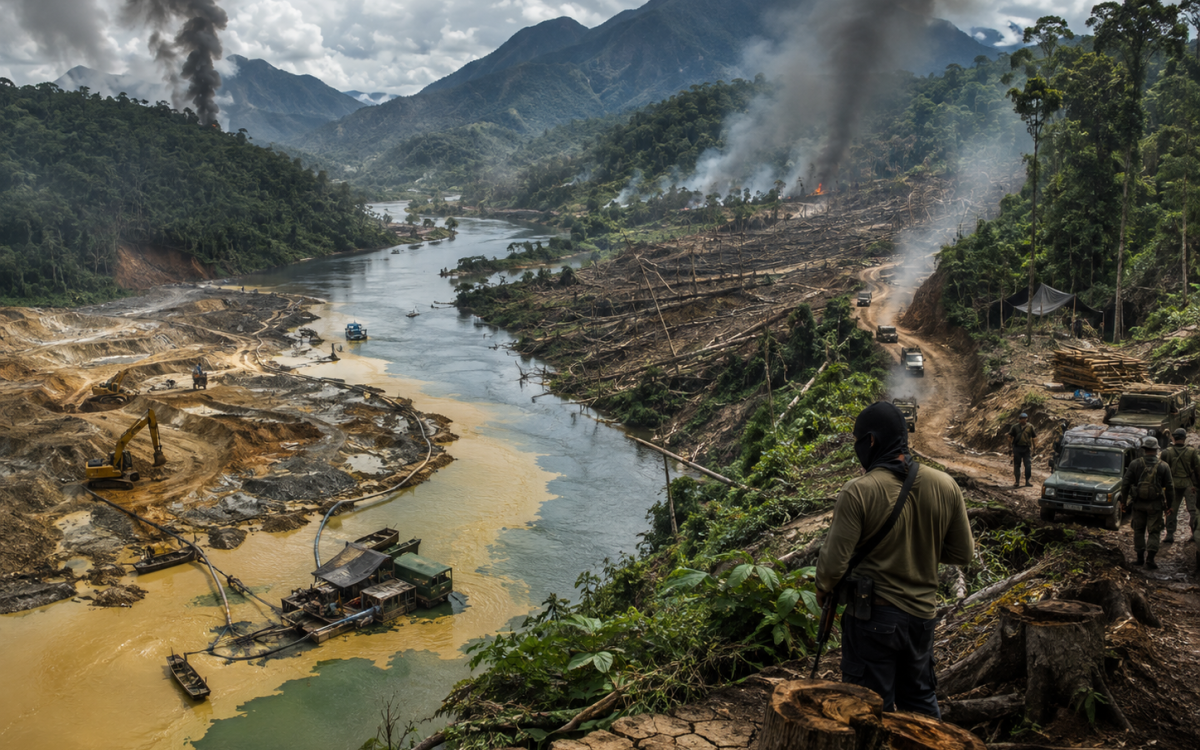
Photo Credit: AI generated image