
Research paper published by Chatham House, September 21, 2026.
A new report by Chatham House examines the risks of using biofuels as a major response to a potential Gulf energy supply shock. The authors argue that while biofuels may appear to offer a rapid substitute for oil imports, large-scale expansion of crop-based biofuel production could undermine food security, accelerate land-use change and increase pressure on forests and biodiversity.
How major economies are turning to biofuels in response to the Gulf energy supply shock
Faced with the prospect of disruptions to Gulf oil supplies, a number of major economies are revisiting the role of biofuels in their energy security strategies. Across both major and emerging economies, governments are expanding or reconsidering biofuel policies as they seek to reduce exposure to global oil market disruptions:
- United States: Record Renewable Fuel Standard targets for 2026-27, including a planned 60% increase in biodiesel and renewable diesel production and the removal of restrictions on E10 sales.
- Brazil: Considering raising ethanol blending from 30% to 32%, with discussions underway on targets of up to 35% ethanol and 20-25% biodiesel.
- Indonesia: Increasing its palm oil-based biodiesel mandate from B40 (a 40 per cent biodiesel blend) to B50 palm oil-based biodiesel (a 50 per cent blend) as part of a new energy security strategy.
- India: Accelerating biofuel deployment, including blending target of 20 per cent bioethanol in petrol and approval of a regulatory framework for E100 fuel.
- European Union: Considering raising ethanol blending limits from E10 to E20 to strengthen energy security, despite significant dependence on imported feedstocks.
- Malaysia: Gradually increasing biodiesel blending from B10 towards B15, with plans to support future B20, B30 and potentially B50 blends.
- Thailand: Raising its biodiesel blending mandate back to 7% after previously reducing it during a period of high palm oil prices, while expanding B20 availability for transport and industry and supporting domestic palm oil producers.
Tensions with food security, forests and land use
According to the report, the land-use implications these biofuel mandates, specifically of Brazil, India, Indonesia and the US, could be significant:
If the increased biofuel mandates proposed in response to the Hormuz crisis are fully implemented, the amount of land required by 2030 could more than double, with 36 million hectares being added – similar in size to Germany.
The report cautions that the scale and speed of biofuel expansion may outpace the development of environmental safeguards, certification systems, land-use planning frameworks and enforcement mechanisms. As demand for feedstocks grows, agricultural production may increasingly expand into new areas or displace existing land uses, contributing to indirect land-use change even when biofuel crops themselves are not cultivated on newly cleared land.
The report further warns that a rapid expansion of crop-based biofuels risks exacerbating existing pressures on food systems and land resources. Many commonly used biofuel feedstocks, including maize, sugar cane, soy and palm oil, compete directly or indirectly with food production for land, water and agricultural inputs. As the authors note:
By prioritizing energy prices and energy security in the short term, some policy responses may be trading off against increased food insecurity in the medium term. As biofuel output increases, so do competition and prices for agricultural inputs and staple commodities that can have a dual purpose as feedstocks and foodstuffs.
The report argues that this risk is particularly acute given existing pressures on global food systems, including climate-related disruptions to agricultural production, recent El Niño impacts on harvests and concerns over fertilizer availability stemming from disruptions to trade flows through the Strait of Hormuz. Drawing on World Bank analysis, the report also highlights a scenario in which a prolonged Hormuz disruption, coupled with El Niño-related agricultural shocks, could push up to 70 million additional people into acute hunger and food insecurity by 2028.
Policy recommendations for the food-energy-land nexus
Recognizing that a push for biofuels to replace Gulf oil could have significant long-term consequences for food security, land use and deforestation, Chatham House puts forward 16 policy recommendations. For the purposes of this article, these recommendations can be grouped into four broad types of intervention: reducing demand for transport fuels; promoting more sustainable and circular use of biomass; strengthening policy coordination and governance; and improving monitoring, traceability and accountability across biofuel supply chains.
Specifically, the report recommends:
1. Reducing demand for transport fuels
Rather than responding to energy insecurity primarily through additional fuel production, governments should first seek to reduce fuel demand through energy-efficiency measures and changes in transport behaviour. The report therefore recommends to:
- Implement measures to curb energy demand in the immediate term, particularly those aimed at increasing energy efficiency.
2. Sustainable feedstock and resource-use measures
Biofuel deployment should prioritize low-impact feedstocks and circular resource use while avoiding competition with food production and pressure on land resources:
- Prioritize food production over biofuels to protect the food security of the most vulnerable populations.
- Develop clear guidance on sustainable biomass use to help ensure that biofuel expansion does not undermine biodiversity targets, ecosystem restoration or anti-deforestation commitments.
- Add binding land-use ‘guardrails’ on the use of biofuels to national bioeconomy strategies.
- Apply a ‘productivity and circularity first’ approach before further raising biofuel mandates.
- Identify early signs of staple crop decline and risks to national and regional food supply before harvests.
- Avoid locking in large-scale, crop-based biofuel systems that incentivize land-use conversion.
3. Strengthen safeguards, standards and monitoring measures
Governments should strengthen monitoring systems and supply-chain transparency to identify risks early and prevent biofuel expansion from driving unsustainable land-use change:
- Strengthen national-level certification and traceability systems to help ensure that higher biofuel demand does not translate into renewed land conversion
- Ensure that standards and certification processes differentiate between feedstocks for biofuels.
- Renew cooperation between governments, producer countries and industry on the development of robust ILUC accounting, traceability and deforestation-free requirements.
- Include long-term structural incentives in policy frameworks to guarantee product origins and prevent fraudulent activities from driving up deforestation and unsustainable land-use changes.
4. Improve governance and policy coordination
Managing the food-energy-land nexus requires stronger coordination across sectors and levels of governance. Specifically, it is recommended to:
- Share information on best practices and lessons learned.
- Align national bioeconomy and circular economy strategies, particularly in situations where rising demand for biomass for energy is combined with limited supplies of agricultural and forestry residues.
- Increase coordination between departments when updating existing bioeconomy strategies.
- Plan land use at the landscape level.
- Require parties to the Convention on Biological Diversity (CBD) to assess biofuel and wider bioeconomy policies within their National Biodiversity Strategies and Action Plans.
Ultimately, the report illustrates the challenges of managing the food-energy-land nexus in an era of geopolitical disruption and climate stress. While biofuels may contribute to energy security objectives, their rapid expansion can also increase pressures on food systems, forests and finite land resources. The authors therefore call for policies that balance immediate energy needs with longer-term goals relating to food security, biodiversity protection and sustainable land use.
This summary is based on extracts from a research paper published by Chatham House and written by Patrick Schröder, Bhargabi Bharadwaj and Richard King. To read the full article, follow this link.
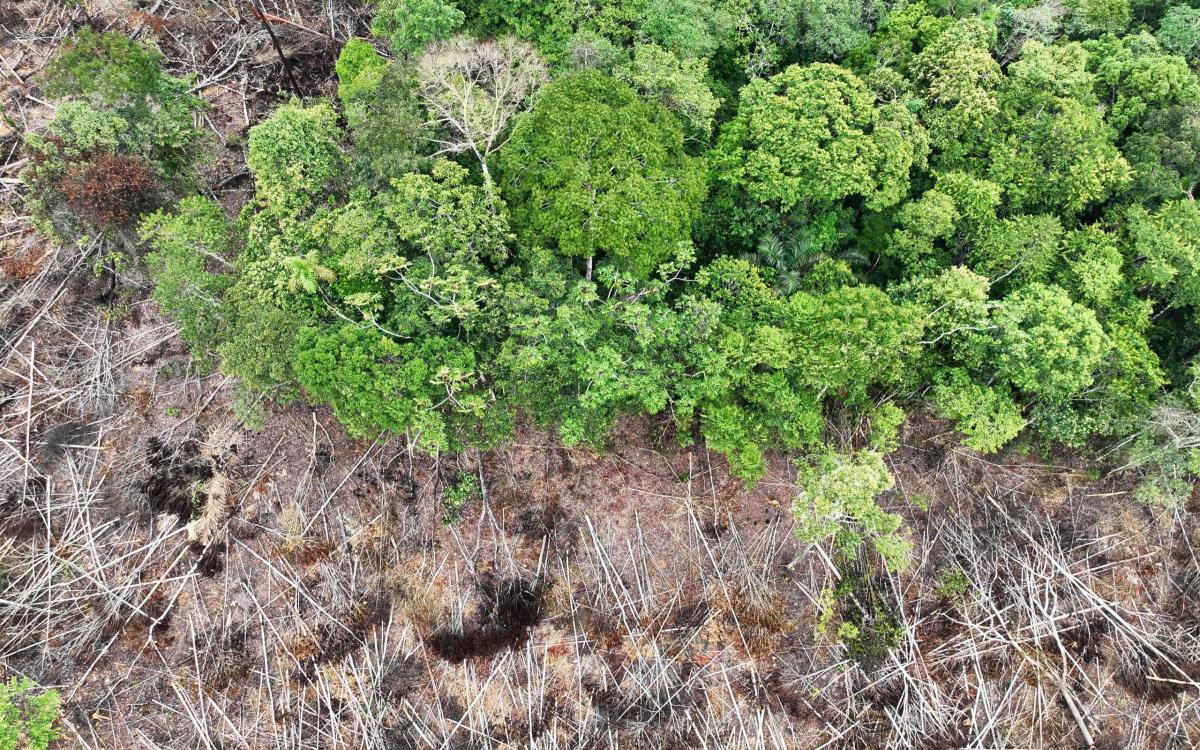
Photo credit: Rhett Butler, “Recent Forest clearing for oil palm in the Ecuadorian Amazon rainforest,” taken on March 31, 2023, via Flickr licensed under CC BY-ND 2.0.